

Realization rate is the share of your standard billing value that you actually collect. Divide what a client paid by what the work would have billed at your standard rates, and that percentage is your realization. It measures the gap between the price on your rate card and the price you got.
Every tool that reports this number was built by somebody selling time tracking, so the fix it points at is always better time tracking. We think that's the wrong end of the problem.
Where the Number Comes From and What It's Really Measuring
Realization compares two prices, one of which is fictional. Your standard rate is what you'd charge if nothing were negotiated, nothing were written off, and every hour recorded were billable. Your collected fee is what the client agreed to pay. The ratio between them is the number.
So a realization gap is the record of a series of decisions. Somebody quoted below the rate card to win the work. Somebody absorbed a scope change without repricing it. Somebody wrote off time at the end because the invoice looked embarrassing next to the estimate. Each of those is a choice, and none of them happens in a timesheet.
Realization percentage in accounting is the same measure under a different name, and firms report it monthly, quarterly and per engagement. Reporting it more often has never once fixed it. The number is a receipt for conversations that already happened.
Realization Leaks Before the Work Starts
The leak happens at the moment the price is agreed and the scope isn't. That single sentence is the argument of this post, and it's the part every ranking article on this topic misses.
Picture the sequence. A prospect asks what it'll cost, you give a number that feels defensible, and they say yes. Nobody writes down what's included, what isn't, and what happens if the records arrive in a shoebox in March.
Six weeks later the work is a third bigger than the number assumed, and you've got two options, both of which show up as a realization gap. You bill the extra and have an uncomfortable conversation, or you eat it.
Firms almost always eat it, for a reason that has nothing to do with economics. The person who'd have to reopen the price is usually the person who built the relationship, and they'd rather absorb four thousand dollars than risk the rapport. Multiply that by a year of engagements and you have a firm with a healthy utilization number, busy staff, and a margin nobody can explain.
The cost side makes the arithmetic sharper. The Bureau of Labor Statistics puts the median annual wage for accountants and auditors at $83,680 in May 2025. Every hour you write off is that salary going out at a price of zero, and no efficiency gain in the delivery process recovers it, because the hour was already worked.
What Is a Good Realization Rate?
A good realization rate is one your firm has deliberately chosen, measured per engagement type, and can explain. Published benchmarks for professional services float around widely and almost none of them state their sample, so we won't quote you a percentage as though it were a standard. What's defensible is the direction. If your realization is falling while your utilization holds, you're selling the same work for less, and the cause is upstream of delivery.
Measure it by service line rather than firm wide. A firm with strong advisory realization and weak compliance realization has a very different problem from one where everything sags, and the firm wide average hides both.
The Three Places the Fee Goes Missing
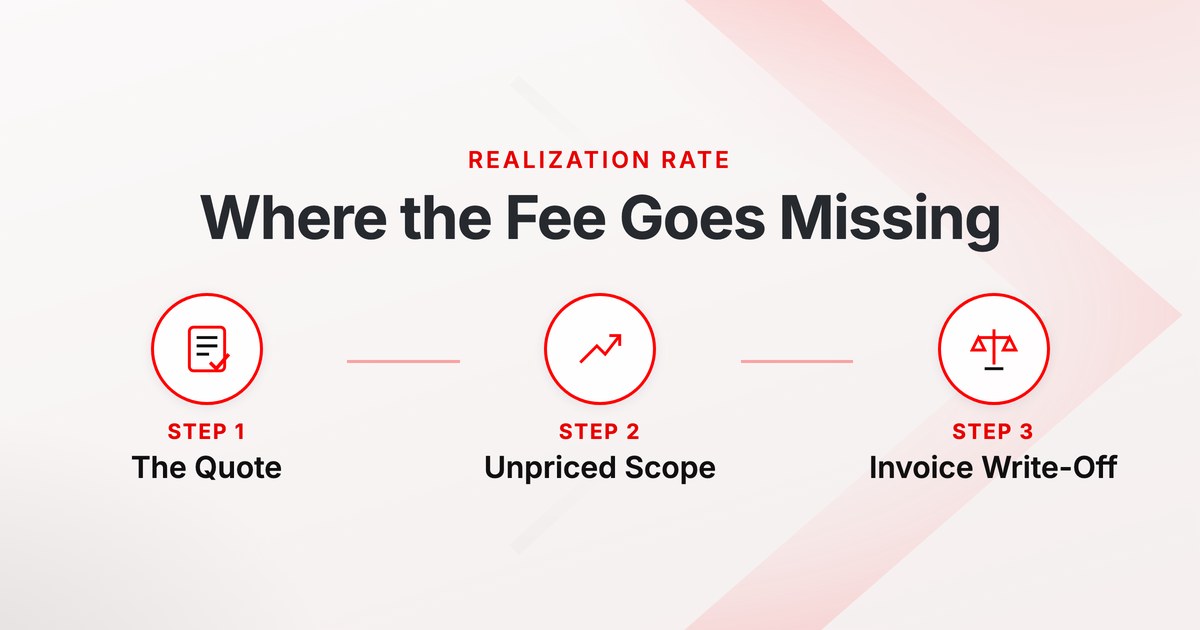
Three moments account for nearly every realization gap we see, and all three happen in conversation rather than in software.
The first is the quote. A firm that prices from a rough hour estimate is guessing at a number under time pressure, usually downward, because the person quoting would rather not lose the work over it. That discount never appears as a discount anywhere in the file. It's simply the price.
The second is the scope change nobody reprices. A client sends the records late, or the structure turns out to be two entities rather than one, or a question becomes a project. The work expands, the fee doesn't, and the firm calls it service.
The third is the write-off at invoicing. Somebody looks at the time recorded, compares it to what the client expects to see, and quietly removes the difference. That decision is usually made alone, at the end of a long day, by a person who'd rather not have the conversation. It's the cheapest moment to fix and the one no dashboard shows you, because by the time it's recorded the decision has already been made.
Track the three separately for one quarter. Most firms find the second one is the biggest, and it's the only one of the three that's genuinely easy to change.
Realization and Utilization Measure Different Failures
Utilization asks whether your people are busy. Realization asks whether being busy was worth it. A firm can be fully utilized and quietly unprofitable, which is the most common shape we see and the hardest to spot from the inside.
The confusion matters because the two numbers suggest opposite remedies. Low utilization says find more work. Low realization says stop selling the work you've got at the price you're selling it. A firm that reads a realization problem as a utilization problem responds by taking on more engagements, which lowers realization further, because the new work is priced by the same conversation that mispriced the last lot.
Watch gross margin alongside both. Margin is where the two numbers finally meet, and it's the one a partner group can't argue with.
Two numbers are worth bringing to the next partner meeting. Realization by service line for the last four quarters, and the count of engagements where the scope changed and the fee didn't. The second one usually isn't recorded anywhere, which is itself the finding, and a firm can reconstruct a quarter of it from memory in about twenty minutes.
What to Change in the Price Conversation

Four changes fix more realization than any billing system will.
Price the outcome rather than the estimate of hours. When the fee is attached to a defined result, a scope change is a new conversation with a new number rather than a silent overrun. We've written about building an upfront core offer and about selling more without selling more hours, and both are versions of this move.
Write the scope down in the same document as the price, in the client's language. The line that protects your realization isn't the fee, it's the sentence describing what happens when the assumptions change.
Decide your zone pricing before the conversation, meaning the range you'll work in and the floor you won't cross, and make sure everyone who can quote knows both. A floor that lives in one partner's head isn't a floor.
Stop competing on price in a market where somebody is always cheaper. Selling tax planning without competing on price is the same discipline applied to one service line, and it works for the same reason.
If you want help building the offer and the price conversation underneath these numbers, that's the work we do in Firm Huddle. Bring your last ten engagements and the fee you actually collected on each, and the pattern usually shows up inside an hour.
FAQ
How to calculate a realization rate?
Divide the fee you collected by the value of the work at your standard rates, then express it as a percentage. If an engagement would have billed at 10,000 dollars at standard rates and the client paid 8,500 dollars, realization is 85 percent. Run it per engagement and per service line, because the firm wide figure averages away the thing you need to see.
What are realization rates?
The plural usually means the rate broken out per engagement, per service line or per person rather than as one firm number. Google returns this question as "What are realisation rates?", with the British spelling, and you'll see that form in law firm and accountancy sources outside the United States. Some of them split it into billing realization, what you invoiced against standard value, and collection realization, what you actually got paid. Worth knowing which one a benchmark means before you compare yourself against it.
What is realization vs utilization?
Utilization is the share of available hours your people spend on billable work. Realization is the share of standard value you collect on that work. Utilization tells you whether the team is busy and realization tells you whether the busyness paid. A firm needs both, and a firm that only watches one usually watches utilization.


