
If you’re searching “outsourced sales companies,” you have already decided that hiring, training, and managing an internal salesperson is not the right next step. You are now in evaluation mode. Comparing providers, trying to figure out what you should actually pay, and trying to read through the range of pricing models that make apples-to-apples comparison feel impossible. This guide covers the two things the definitional articles skip. What outsourced sales actually costs an accounting firm, and how to choose a provider without getting burned.
If you need the ground floor first, we’ve covered what sales outsourcing is and who it’s for and how sales outsourcing services work in practice. This page assumes you know the model and want the numbers.
The Three Models, Priced Differently
Pricing only makes sense against the engagement structure, so here is the 30-second version. Full outsourcing means an external team owns your sales function end-to-end and your team hands off leads and receives signed engagements. Hybrid means the external team handles top-of-funnel outreach and qualification while your partners handle the consultation and close, which is the most common structure for accounting firms because the trust transfer at the consultation stage is hard to outsource. Fractional means an external sales leader manages your sales function part-time without making the calls themselves, the cheapest entry point. Each model prices differently, which is why “what does outsourced sales cost” has no single answer.
One misconception to clear before spending anything. Outsourced sales is not a lead generation service. If your problem is “we have no leads,” outsourcing sales will not fix it. That is a marketing problem dressed up as a sales problem, and the diagnosis is usually different from what firms assume.
What Does Outsourced Sales Cost for a CPA or Tax Firm?
Retainer Models vs. Commission-Only vs. Performance-Based
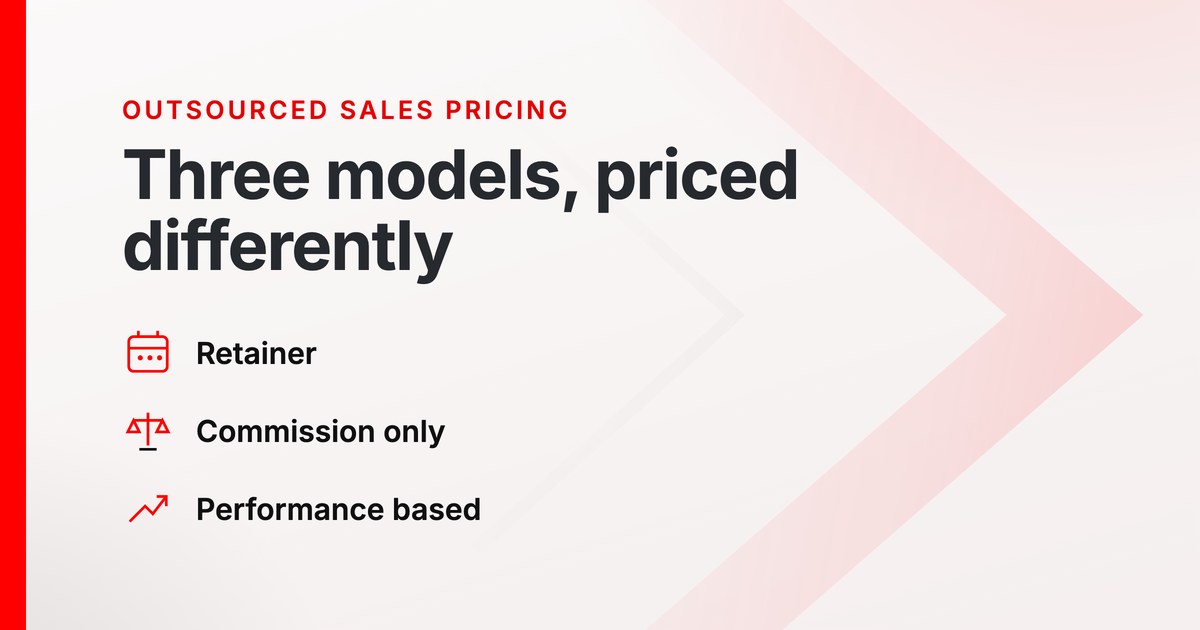
Pricing in the outsourced sales market falls into three broad structures, and they are not interchangeable.
Retainer models charge a fixed monthly fee, typically $4,000-$12,000/month for accounting-firm-specific providers, sometimes higher for enterprise-focused firms. The retainer buys you a dedicated team, a defined number of hours or calls per month, and a process. The strength is predictability. You know what you’re paying and what you’re getting. The weakness is that the incentive to perform is softer, because the retainer gets paid regardless of whether deals close.
Commission-only models charge a percentage of closed revenue, typically 10-25% for the first year of an engagement. The strength is alignment. The provider only gets paid when you do. The weakness is that commission-only providers are highly selective about which firms they take on, because they are bearing the pipeline risk. Firms with weak pipelines, undefined services, or short track records usually cannot get a commission-only deal.
Performance-based or hybrid models combine a smaller retainer with a commission on closed deals, often $2,000-$5,000/month plus 5-15% of first-year revenue. This is the most common structure for accounting-firm-specific outsourced sales, and it balances the provider’s need for predictable cash flow with your need for aligned incentives.
What to Budget in Year 1
For an accounting firm doing $1M-$5M in revenue, a realistic Year 1 outsourced sales budget falls in the $50,000-$120,000 range all-in, whether that’s retainer, hybrid, or retainer-plus-commission. Below $50,000 you are usually buying a fractional sales leader, not a full outsourced team. Above $150,000 you are usually buying a full team with significant dedicated capacity, and at that point you should be measuring ROI like a serious investment.
The number that matters more than the absolute budget is the cost-per-acquired-engagement. If you’re paying $8,000/month and closing one $40K advisory engagement per quarter, your cost per acquisition is $24,000 to win $40,000, that works. If you’re paying $8,000/month and closing nothing, the budget is wrong, not the model.
What You Get for the Money
The spending only makes sense against a realistic results curve, and we’ve published that separately. Our ROI framework for outsourced sales covers the baseline numbers to capture before you sign, what should shift in the first 90 days, and the close-rate math that tells you whether an engagement is working. The short version is that month one is process build, not closed deals, and a provider promising otherwise is either selling to a warm pipeline they brought with them or lying. For what a real engagement looks like inside an accounting firm, from starting point to outcomes, the TRM CPA case study walks through one end to end.
How to Choose an Outsourced Sales Company for Your Accounting Firm
5 Questions to Ask Before Signing
- “What percentage of your clients are accounting firms?” If the answer is under 25%, you are a vertical experiment. The learning curve will be billed to you.
- “Who specifically will be doing the work on my account?” Many providers sell with the founder and deliver with a junior account manager. Get the name and the tenure of the person who will actually be on your calls.
- “What does the first 90 days look like, week by week?” A credible provider has a documented onboarding and process-build plan. A vague answer means they are making it up on your dime.
- “How do you handle the consultation and close?” This is where accounting firms are most sensitive. Some providers want to be in the room; some insist your partners stay in the room. Match the model to your comfort level.
- “What does success look like at day 90, and what does failure look like?” A provider who can articulate failure is a provider who has seen it and learned from it. A provider who can only articulate success is selling.
Red Flags in Outsourced Sales Contracts
- Long lock-in periods (over 6 months) with no performance off-ramp. A confident provider earns renewal, not captivity.
- Pricing that is opaque about what activities the fee covers. “Sales services” is not a deliverable.
- Guarantees of specific revenue numbers without seeing your pipeline, your close rate, and your average deal size. Nobody can honestly guarantee revenue they have not modeled.
- No access to the CRM or the pipeline. If the provider will not let you see the work in progress, the work is usually not happening.
Outsourced Sales vs. Hiring a Full-Time Salesperson
The comparison is not “outsourced or hired.” It is “which problem am I solving.” A full-time hire solves a capacity and ownership problem. Outsourced sales solves a speed and expertise problem. You need a working sales function in 60 days, not 12 months, and you need expertise you don’t have on the bench. We’ve written up the full build-vs-outsource decision separately; the cost-relevant point is that hiring a salesperson before you have a sales process is the most expensive way to learn which problem you actually had.
Is Sell Up the Right Fit for Your Firm?
We are not the right fit for every accounting firm. We are the right fit for firms that have a real service to sell, a partner or team willing to stay in the consultation room, and a willingness to treat sales as a system instead of a personality trait. If you are pre-revenue, selling a commoditized compliance product on price, or looking for a vendor to hand you leads, we are not the right call.
If you are comparing outsourced sales options and want a straight answer on whether our model fits your firm, book an introductory call.