


Sales outsourcing is often positioned as a way to improve sales performance without the fixed costs of building an internal team. For professional services like accounting, tax advisory, and bookkeeping firm owners, the appeal is straightforward: more capacity, more consistency, and a clearer path to revenue growth.
But in practice, most accounting and tax advisory firms don't struggle because they lack demand. They struggle because the demand they already have isn't being converted consistently. Leads come in, calls get booked, and opportunities exist, but without a structured enrollment system, outcomes vary from week to week.
Sales outsourcing, when done correctly, isn't just about adding people to your firm. It's about installing a repeatable process that ensures every prospect is handled the right way, from the first inquiry to a signed engagement. That includes how quickly leads are contacted, how conversations are structured, and how prospects are guided toward a clear decision.
These arrangements typically involve external sales teams or specialist agencies managing key parts of the sales process for accounting firms, from initial lead handling through closing. This allows accounting and tax advisory firm owners to stay focused on client work and deliverables while improving how revenue is generated.
Even firms with strong referral pipelines or consistent inbound leads often hit a ceiling because follow-up is inconsistent or conversations aren't structured. A well-built sales system solves that by introducing clear workflows, defined messaging, and consistent execution, all of which lead to better conversion and more predictable revenue for your CPA, tax planning, or advisory practice.
What Are Sales Outsourcing Services and Their Role in Accounting and Tax Advisory Firm Growth?
Sales outsourcing refers to engaging external teams to handle sales functions on behalf of a business. For accounting, tax strategy, bookkeeping, and CFO advisory firms, this typically includes responding to inbound leads, running discovery calls, and guiding prospects through a structured enrollment process.
Accounting and tax advisory clients don't buy the same way as typical B2B buyers. They're often skeptical, financially aware, and evaluating trust as much as price. A tax planning prospect who's been burned by vague promises wants specifics: what will this save me, and how fast. A bookkeeping client evaluating three firms is comparing confidence as much as cost. That means the sales process for accounting firms needs to reflect how these clients actually make decisions.
Outsourced sales teams bring both skill and structure. Instead of relying on inconsistent conversations or reactive follow-up, they introduce a defined process that ensures every accounting or tax advisory lead is handled consistently, with faster response times, clearer service positioning, and a more controlled path from initial interest to a signed engagement letter.
When implemented properly, this doesn't just increase sales activity for your firm. It improves conversion rates. And more importantly, it allows accounting and tax advisory firm owners to scale without relying entirely on their own time to close every deal.
How Do Outsourced Sales Teams Integrate with Accounting and Tax Advisory Firms?
Integration starts with understanding how the accounting or tax advisory firm currently operates: its service offerings, ideal client profile, pricing structure, and any existing sales process, even if that process is informal or inconsistent.
From there, roles and workflows are defined so internal and external teams can operate without friction. This includes setting expectations around lead handling, communication cadence, reporting, and performance metrics specific to the accounting industry.
For accounting and tax advisory firms, successful integration also requires translating complex services into clear, outcome-driven conversations. Prospects don't buy tax strategy or advisory services. They buy certainty, tax savings, and confidence in their numbers. A CFO advisory client wants to know what their cash flow looks like in 90 days. A tax planning client wants to know exactly how much they'll save this year. The sales process needs to reflect that specificity.
When that alignment is in place, the outsourced team doesn't feel separate. It functions as a structured extension of the firm's growth engine, speaking the language of accounting clients and handling objections that are specific to tax planning, bookkeeping, and advisory services.
What Types of Sales Outsourcing Services Are Available for Accounting and Tax Advisory Firms?
Sales outsourcing can take different forms depending on where an accounting or tax advisory firm is experiencing bottlenecks in its sales process.
Outsourced Sales Teams for Accounting Firms
These are full-cycle sales teams that handle everything from lead follow-up to closing on behalf of the accounting or tax advisory firm. For firms with consistent lead flow, whether from referrals, paid ads, or organic channels, this is often the most impactful model. The outsourced team handles enrollment conversations so firm owners and their teams can focus entirely on delivery.
Cold Outreach Support
Focused on generating new opportunities through outbound prospecting. This is more relevant for accounting and tax advisory firms that don't yet have a steady inbound pipeline and need to build their prospect list from scratch.
Sales and Offer Consulting
Designed to improve the performance of the firm owner or internal team. This is the right fit when an accounting or tax advisory firm wants to keep sales in-house but needs more structure: clearer packaging, better pricing strategy, and a defined enrollment framework. Sell Up's Firm Huddle program is built specifically for this: a structured advisory enrollment system for accounting and tax strategy firms doing $300K to $2M who need to fix their offer before they can scale.
Most accounting and tax advisory firms benefit from a combination of these approaches. The right mix depends on where deals are currently being lost, whether that's at lead generation, follow-up, or the closing conversation itself.
What Are the Key Benefits of Outsourced Sales Solutions for Accounting and Tax Advisory Firms?
For accounting and tax advisory firm owners, the biggest benefit isn't cost savings. It's consistency and the elimination of the revenue leak that comes from unstructured, owner-dependent sales processes.
Reduced Overhead
Outsourcing eliminates the need to hire, train, and manage a full internal sales function. For most accounting and bookkeeping firms under $2M in revenue, a full-time internal salesperson is premature. Outsourcing gives you professional sales execution without the fixed cost of a W-2 hire.
Access to Accounting Industry-Specific Sales Expertise
You're working with sales professionals who focus entirely on accounting and tax advisory firm enrollment, not splitting their time between client work and business development. Sell Up's team has generated over $16 million in revenue for accounting, tax strategy, and bookkeeping firms in 18 months, closing deals daily. That means real-time data on what packaging, pricing, and positioning actually converts in this industry, not theory.
Scalability Without Long-Term Hiring Commitments
Sales capacity can be adjusted based on lead volume and growth stage without the friction of hiring cycles or severance risk.
The 2025 Ignition U.S. Accounting and Tax Pricing Benchmark Report found that the era of hourly billing in accounting is fading fast: only 10% of client advisory service practices still use hourly billing as their primary pricing method, and hourly billing for CFO and controller services dropped from over 20% to 10% in a single year. Meanwhile, 4 in 5 accounting firms plan to raise prices in 2026, with more treating pricing as a profitability strategy rather than a cost reaction. (Source: Ignition, 2025 U.S. Accounting and Tax Pricing Benchmark Report, via CPA Practice Advisor)
The real advantage shows up in how leads are handled day to day. Most accounting firms lose revenue not because they lack prospects, but because follow-up is slow, inconsistent, or the offer itself isn't structured to close in a single conversation. Outsourcing installs the structure that ensures every lead is worked properly, and that's where conversion improves.
Inside Public Accounting's 2025 Data Dive found that despite steady nominal revenue growth, accounting firms' actual revenue per employee has been outpaced by inflation, meaning firms are generating less real value per person than they were a decade ago. The 2025 Rosenberg Survey identifies the cause directly: most accounting firms are still operating on a high-volume, low-price compliance model. Whether it's the firm owner or a team member handling sales conversations without a defined system, the result is the same: inconsistent outcomes and unpaid time spent on deals that don't close. An outsourced sales team eliminates that drain entirely, replacing ad hoc conversations with a professional, repeatable enrollment process that doesn't depend on internal bandwidth. (Sources: Inside Public Accounting Data Dive, May 2025; Rosenberg Survey, 2025)
Why Do Accounting Firm Owners Struggle to Convert Leads and What Fixes It?
External sales teams bring structure to what is often an unstructured, owner-dependent process inside accounting and tax advisory firms. Instead of relying on individual conversations that vary in quality from week to week, they use defined frameworks for discovery, follow-up, and closing.
They also create visibility. By tracking performance data across every step of the enrollment process, they can identify exactly where accounting firm prospects are being lost, whether that's no-shows before a discovery call, weak problem-solution framing during the meeting, or unclear offer presentation at the close.
Inside Public Accounting's 2025 Data Dive found that accounting firms' real revenue per employee has been outpaced by inflation over the past decade, even as nominal revenue grows. The 2025 Rosenberg Survey points directly to the cause: most accounting firms are still running a high-volume, low-price model that compresses margins regardless of how hard the team works. Whether it's the firm owner or a staff member running sales conversations without a defined system, the pattern is the same: inconsistent close rates, unpaid time per prospect, and a process that can't scale. (Sources: Inside Public Accounting Data Dive, May 2025; Rosenberg Survey, 2025)
One of the most common conversion killers for accounting and tax advisory firms is the custom-quoting trap: spending 2 to 4 hours per prospect building a personalized proposal, only to have the prospect ghost after the presentation call. An outsourced sales system replaces custom quoting with a structured upfront offer, one to three clear packages with fixed pricing, that closes in a single conversation and eliminates the back-and-forth entirely.
This allows for continuous improvement. Messaging gets refined, objections specific to tax planning and advisory services are handled more effectively, and conversion rates increase over time. The result is a sales process that produces consistent outcomes instead of unpredictable ones.
What Measurable Outcomes Can Accounting and Tax Advisory Firms Expect?
When sales is structured correctly for an accounting or tax advisory firm, the results are clear and measurable:
- Higher lead-to-client conversion rates, without increasing marketing spend
- Faster time-to-close, often reducing 2 to 3 call sales cycles down to a single enrollment conversation
- Improved client retention driven by better-fit clients enrolled through a value-based process
- More predictable monthly recurring revenue from fixed advisory packages and annual contracts
- Immediate cash flow from upfront diagnostic packages priced at $2,500 to $10,000
These outcomes don't come from doing more activity. They come from doing the right activity consistently, with a repeatable enrollment system that any accounting firm owner can run, delegate, or hand off to their team.
For accounting and tax advisory firms, this often means turning the referrals and inbound leads they're already receiving into significantly more revenue, without adding a single dollar to the marketing budget.
How Does the Sales Outsourcing Process Work for Accounting and Tax Advisory Firms?
Most outsourced sales engagements for accounting and tax advisory firms follow a defined structure to ensure alignment from day one and measurable execution from week one.
Initial Engagement
Goals, performance expectations, and metrics are clearly defined before any sales activity begins. For accounting and tax advisory firms, this includes identifying the ideal client profile, whether that's business owners doing $500K to $5M, real estate investors, or high-income W-2 earners, and the services being positioned.
Onboarding
The sales team is trained on the firm's services, positioning, pricing, and enrollment process. This phase is critical for accounting and tax advisory firms because generic sales training doesn't work. The team needs to understand the difference between a tax savings conversation and a bookkeeping ROI conversation, and how to move a skeptical accounting prospect from interest to commitment.
Execution
The team begins handling leads, running enrollment calls, and implementing the sales process. Performance is tracked against defined KPIs and reviewed regularly so messaging can be refined based on what's actually converting in the market.
What Are the Step-by-Step Phases of Outsourced Sales for Accounting Firms?
A well-structured outsourced sales engagement for an accounting or tax advisory firm moves through three phases:
- Needs assessment: identifying where the firm's current sales process is breaking down and what's costing the most revenue
- Provider selection and alignment: choosing a partner with documented, accounting-industry-specific experience and agreeing on performance benchmarks
- Contract alignment and kickoff: establishing clear terms, expectations, and a defined ramp period before full execution begins
Each phase reduces risk and ensures that the partnership is built on clear expectations and measurable outcomes, not activity metrics that look good on paper but don't translate to signed engagement letters.
How Is Sales Training Integrated into an Accounting Firm's Sales Process?
Training is a core component of successful outsourced sales for accounting and tax advisory firms, and it's what separates a generic sales team from one that can actually close a tax planning or CFO advisory engagement.
Effective training for accounting firm sales professionals covers how to explain complex services in simple, outcome-focused language. A tax strategy client doesn't want to hear about your methodology. They want to know: what am I paying too much in taxes right now, and what does fixing that look like?
For firms that want to keep enrollment in-house, Sell Up's Firm Huddle program installs the full training framework directly into the firm owner's process: problem-solution mapping, one-call enrollment scripts, objection handling specific to tax and advisory services, and pre-call and post-call sequences that warm prospects and reinforce commitment.
Ongoing performance coaching, including AI-powered call analysis and live roleplay, ensures that conversion improves over time and that the firm's enrollment language stays sharp as the market evolves.
How to Choose the Right Sales Outsourcing Company for Your Accounting or Tax Advisory Firm
Not every outsourced sales firm understands how accounting and tax advisory clients buy. Most generic sales outsourcing companies apply the same playbook they use for SaaS or e-commerce, and it doesn't work for accounting firm prospects who are skeptical, financially sophisticated, and evaluating trust above all else.
The right partner for an accounting or tax advisory firm should understand the industry from the inside: why prospects stall, what objections come up around pricing and commitment, and how to move a referral from a warm introduction to a signed annual advisory engagement.
What Criteria Should Accounting and Tax Advisory Firms Use to Evaluate a Sales Outsourcing Partner?
Key factors to evaluate:
- Documented experience closing accounting, tax planning, bookkeeping, or CFO advisory engagements, not just general professional services
- Real performance data from accounting firm clients: conversion rates, revenue generated, average deal size
- The ability to adapt to your specific service model, whether that's tax strategy, bookkeeping, fractional CFO, or full-service advisory
- Clear performance tracking with defined KPIs tied to revenue outcomes, not just activity metrics like calls made or emails sent
- A structured onboarding process that gets the sales team fluent in your firm's offer before they ever talk to a prospect
How Does Sell Up Differentiate from Other Sales Outsourcing Options for Accounting Firms?
Sell Up is not a general sales outsourcing firm that happens to work with some accounting clients. It is the largest outsourced sales firm built exclusively for the accounting industry, and that specificity is the differentiator.
Sell Up's sales professionals close deals daily for tax planning firms, bookkeeping firms, tax advisory practices, and CFO advisory firms across the country. In 18 months, the team has generated over $16 million in revenue for accounting firm clients. That's not historical data. It's real-time market intelligence on what's converting right now: what objections accounting prospects raise this quarter, what pricing structures close faster, and what language works for a tax savings conversation versus a bookkeeping ROI pitch.
Instead of applying a generic sales framework and hoping it translates, Sell Up builds enrollment processes around how accounting and tax advisory clients actually make decisions, including how trust is built, how commitment is earned, and what drives a prospect to move forward in a single conversation instead of ghosting after a proposal.
For firms that aren't yet ready for full sales outsourcing, typically accounting or tax advisory firms under $1M in revenue who need to fix their offer before they can scale, Sell Up's Firm Huddle program installs the complete enrollment system directly into the firm. The Sales Firm model is designed for established firms doing $1M or more with consistent lead flow who are ready to hand off the sales function entirely.
What Are Common Pricing Models for Outsourced Sales in the Accounting Industry?
Outsourced sales pricing for accounting and tax advisory firms typically follows one of three structures:
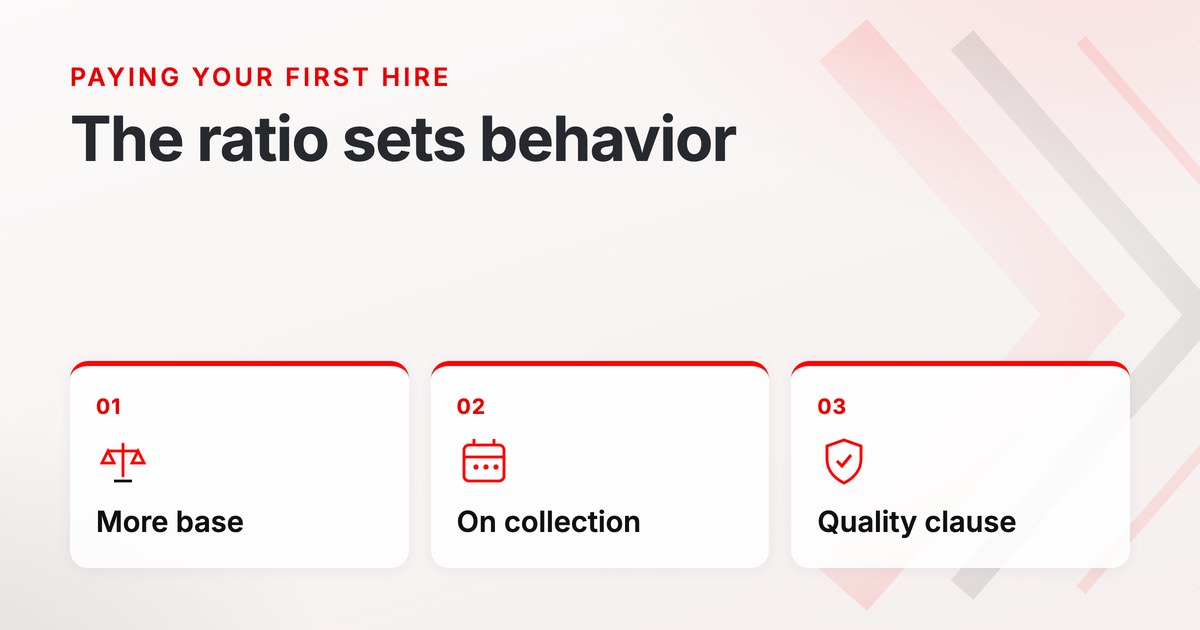
- Commission-based: The outsourced team earns a percentage of each closed deal. This aligns incentives directly with revenue outcomes and reduces upfront risk for the firm.
- Flat monthly retainer: A fixed monthly fee for defined sales services. This works well for accounting firms with consistent lead volume who want predictable costs.
- Performance-based hybrid: A base retainer combined with performance bonuses tied to specific conversion milestones or revenue targets.
Each model balances risk and incentive differently. Commission-based arrangements give accounting firms maximum cost flexibility but require a clear tracking system for attribution. Flat retainers provide budget predictability but require defined performance expectations built into the agreement. The right model depends on the firm's revenue stage, lead volume, and growth goals.
What Should Accounting Firms Expect in Sales Outsourcing Contracts?
A well-structured outsourced sales contract for an accounting or tax advisory firm should include:
- Scope of services: Exactly what the outsourced team will and will not handle, including lead follow-up, discovery calls, closing, CRM updates, and reporting
- Performance expectations: Defined KPIs with review cadence, including conversion rates, number of enrolled clients per month, and pipeline value
- Confidentiality terms: Protections for client data, prospect lists, and proprietary firm information
- Duration and ramp period: A defined ramp window before full performance benchmarks apply, typically 30 to 60 days for accounting industry-specific onboarding
- Exit conditions: Clear terms for termination, notice periods, and what happens to pipeline and client relationships at the end of the engagement
Understanding these terms upfront, before signing, ensures alignment and eliminates the friction that comes from mismatched expectations three months into an engagement.
What Do Case Studies Show About Outsourced Sales for Accounting and Tax Firms?
The clearest picture of what structured sales outsourcing produces for accounting and tax advisory firms comes from firms that have implemented a defined enrollment system, whether through a fully outsourced team or through Firm Huddle's advisory system build.
Accounting and tax advisory firm owners who install a structured offer and enrollment process consistently report faster time-to-close, often collapsing a 2 to 3 call process into a single conversation, higher average engagement value from fixed packages replacing custom quotes, and immediate cash flow improvements from upfront diagnostic packages.
Firms that previously spent 2 to 4 hours per prospect in unpaid custom-quoting work have recaptured that time while increasing close rates, because prospects who pay for a diagnostic are dramatically more likely to convert to ongoing advisory services than prospects who received a free consultation and then shopped around.
What Industry Trends Support Outsourced Sales for Accounting and Tax Advisory Firms?
The accounting industry is undergoing a significant shift. Firm owners who built their practices on compliance work, including tax prep, bookkeeping, and audit, are being squeezed by automation, commoditization, and client price sensitivity. The firms growing fastest are the ones moving upstream into advisory services: tax planning, CFO advisory, wealth strategy, and business consulting.
According to the 2024 CPA.com and AICPA PCPS Client Advisory Services Benchmark Survey, reported by Inside Public Accounting, client advisory services (CAS) is now the fastest-growing service area in public accounting. Firms reported 17% median revenue growth and median CAS revenue rising 61% since 2022. Firms that shifted to CFO and business insights services earned more than 30% higher monthly recurring revenue than those still anchored in transactional work. (Sources: CPA.com and AICPA PCPS CAS Benchmark Survey, 2024; Inside Public Accounting, December 2024)
But advisory services require a different kind of sales process. You can't close a $10,000 annual tax strategy engagement the same way you sell tax prep. Prospects need to understand the value, trust the firm's expertise, and commit to a relationship, not just a transaction. That's exactly where structured sales outsourcing and enrollment system design become a competitive advantage.
More accounting and tax advisory firm owners are turning to outsourced sales and offer optimization programs because the alternative, owner-dependent or team-dependent, inconsistent, custom-quoting every prospect, doesn't scale. As advisory service demand grows and competition for high-value accounting clients increases, the firms with a repeatable, professional enrollment process will win a disproportionate share of the market.
Frequently Asked Questions
What are the potential risks associated with sales outsourcing for accounting and tax advisory firms?
The primary risk is misalignment: an outsourced team that doesn’t understand how tax planning or advisory clients make decisions will erode trust faster than it builds pipeline. The fix is a partner with documented, accounting-specific experience, clear SLAs, and a structured onboarding process that gets the team fluent in your offer before they speak to a single prospect.
How can accounting and tax advisory firms measure the success of their outsourced sales teams?
The most meaningful KPIs are conversion rate, average engagement value, time-to-close, and monthly recurring revenue generated, not activity metrics like calls made or emails sent. Firms should also track dropout points in the enrollment process to identify exactly where prospects are going dark and tighten the system accordingly.
What types of accounting and tax advisory firms benefit most from sales outsourcing?
Firms doing $1M or more with consistent lead flow but inconsistent conversion benefit most from full sales outsourcing, while firms under $1M benefit most from offer optimization and enrollment system design first. Trying to outsource a broken sales process just produces more of the same broken results: fix the offer, install the framework, then scale.
How does sales outsourcing impact client relationships in accounting and tax advisory firms?
When done correctly, prospects who go through a structured, value-driven enrollment process arrive as better-fit clients who have already committed to an annual engagement rather than a month-to-month arrangement. Poor integration creates the opposite, so the safeguard is rigorous onboarding and a sales team that speaks the language of accounting clients authentically, not with generic closing tactics.
Can sales outsourcing be a long-term strategy for accounting and tax advisory firm growth?
Yes, and for firms scaling past $1M it’s often the only model that works sustainably, because owner-dependent or team-dependent sales without a defined system doesn’t scale regardless of who is running the calls. Firms that treat outsourced sales as a living system, coached, measured, and refined as their service mix evolves, compound their growth. Firms that treat it as fixed-and-forget stagnate.
Conclusion
Sales outsourcing gives accounting and tax advisory firm owners what most can't build on their own: a consistent, professional enrollment process that converts leads into high-value advisory clients, without the firm owner or their team being the bottleneck in every deal.
The accounting industry is moving toward advisory services. The firms that will lead that shift are the ones with a structured offer, clear pricing, and a repeatable enrollment system, whether that system is run by an outsourced sales team or built into the firm's own process through a program like Firm Huddle.
With the right structure in place, accounting and tax advisory firms can turn the referrals and leads they're already receiving into consistent, predictable revenue, without adding overhead, without custom-quoting every prospect, and without relying entirely on the owner's time to grow.
Ready to install a sales system built for accounting and tax advisory firms? Visit wesellup.com to learn about the Sales Firm and Firm Huddle programs.


%20(1).jpg)