

The fractional model is well understood in accounting circles. You have fractional CFOs, fractional CMOs, fractional controllers. A fractional sales manager is the same idea applied to the part of the firm most partners would rather not think about, the sales function. You get an experienced sales leader for a fraction of the cost of a full-time hire, with the trade-off being that they are not in the building every day.
This guide covers what a fractional sales manager actually does inside an accounting firm, when the model makes sense, when it doesn’t, and how it differs from the other options you’re probably weighing.
What Is a Fractional Sales Manager?
A fractional sales manager is a senior sales leader who manages your sales function part-time, typically 10-25 hours per month, for a retainer well below the cost of a full-time sales manager or director. They are not a salesperson making calls. They are the person who builds the process, coaches the people making calls, oversees the pipeline, and reports to the partners on what is and isn’t working.
The Difference Between Fractional, Part-Time, and Outsourced
The terms blur, and providers use them inconsistently. The useful distinction is this.
- Part-time describes hours. A part-time sales manager works two or three days a week for your firm. The role is internal, just reduced in scope.
- Fractional describes ownership at reduced capacity. A fractional sales manager typically serves 2-5 clients, spends a defined block of time on each, and owns the sales function for each during that block. The role is external, structured, and usually retainer-based.
- Outsourced sales describes a team that does the selling, not just manages it. Outsourced is execution; fractional is leadership. The distinction matters for what you actually buy.
What a Fractional Sales Manager Actually Does in an Accounting Firm
In a typical 15-hour/month engagement, the work breaks down roughly as follows.
- Pipeline review, 3-5 hours a month. Weekly pipeline meetings with the partners or the team. Deal-by-deal status, next-step assignment, stuck-deal diagnosis.
- Coaching, 4-6 hours a month. Call review against recorded consultations, role-play on specific objections, pre-call prep for high-stakes meetings. This is where the behavior change actually happens.
- Process build, 3-4 hours a month. Refining the discovery framework, the proposal template, the follow-up cadence. Sales is a system; the system needs maintenance.
- Reporting and strategy, 2-3 hours a month. Monthly partner-level review. What’s working, what isn’t, what to change. This is the meeting that keeps the engagement honest.
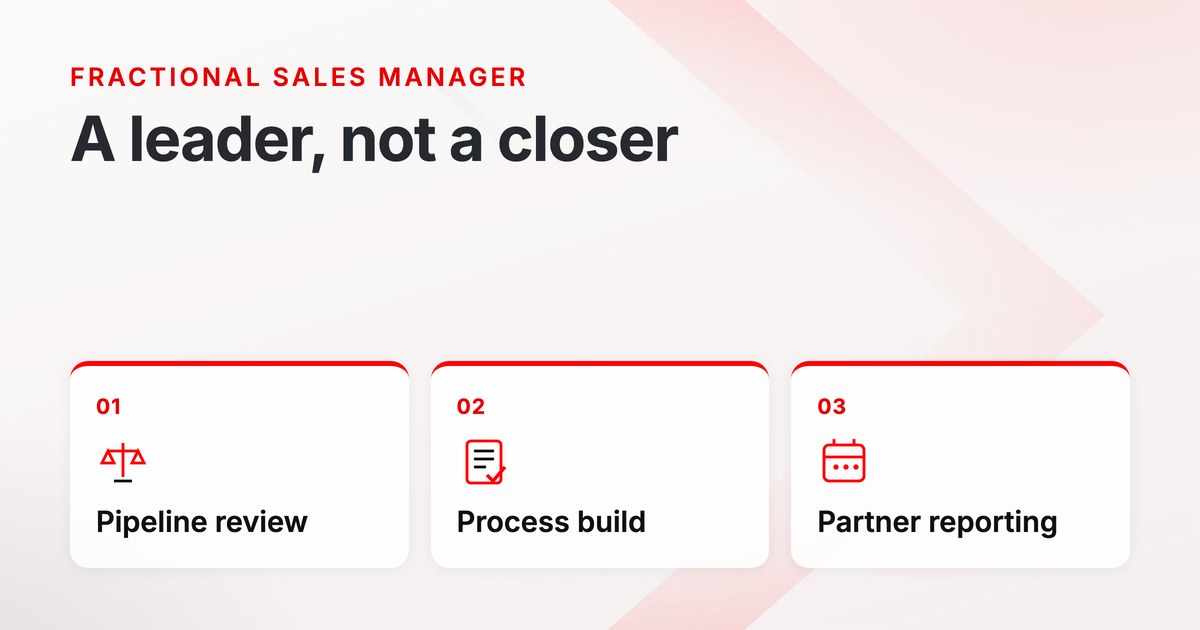
The throughline is that a fractional sales manager is a leader, not a closer. If you need someone to close deals for you, that’s a different role.
When a Fractional Sales Manager Makes Sense
You Have Leads But They’re Not Converting
This is the textbook fit. Your marketing or referral engine is producing consultations, but your partners are closing at 20% when the industry benchmark for similar work is 40%. The problem is not pipeline. It’s conversion. A fractional sales manager diagnoses where in the consultation the deals are dying, builds the fix, and coaches the team through it. This is the highest-ROI use case for the model.
Your Partners Are Doing All the Selling
If every consultation has to involve a partner, your firm has a ceiling on growth that no amount of marketing will fix. A fractional sales manager’s job is to make the partners less essential to the close, by building the process, training the team, and putting in place the discovery and follow-up frameworks that let senior staff run the meetings. This is uncomfortable for partners who like selling, and it is the only path to scaling a firm past partner capacity.
You Can’t Justify a Full-Time Sales Hire Yet
A full-time sales director at an accounting firm runs $150,000-$250,000 all-in, and the role often takes 9-12 months to pay back. A fractional sales manager runs $4,000-$10,000/month and can be live in 30 days. For firms between $1M and $5M revenue, the fractional model is usually the bridge. You get the leadership now, build the pipeline, and graduate to a full-time hire when the numbers justify it.
Timeline and Deliverables to Expect
A credible fractional engagement has a shape.
- Month 1. Diagnostic and process build. Pipeline audit, discovery framework, proposal template, follow-up cadence defined. First coaching sessions against live deals.
- Month 2. Coaching cadence live. Weekly pipeline meetings running. First measurable close-rate movement, usually modest (3-7 percentage points).
- Month 3. Process compounding. Close rate improvement more visible (8-15 points is a realistic quarter-one delta if the baseline was weak). Pipeline hygiene becomes a habit, not a project.
- Months 4+. Optimization phase. The framework is in place; the work shifts to expanding the team’s range, refining the ICP, and building the case for a full-time hire when the volume justifies it.
If you’re not seeing process and coaching live by the end of month one, the engagement is being run as a retainer-harvest instead of a leadership engagement. That is a provider problem, not a model problem.
Fractional Sales Manager or Sales Training, Which Do You Need?
The two are often confused because both touch the same skills. The distinction matters.
- Sales training teaches skills. It is an event or a curriculum with an end date. Good for raising the team’s baseline competence in a defined area (discovery, closing, objection handling).
- A fractional sales manager builds and runs the system in which those skills are applied. Skills without a system do not get used. A system the team cannot execute does not run.
The right sequence for most accounting firms is to diagnose first and buy second. A fractional manager, or a coaching cycle that reviews your team’s real calls, tells you where the gap actually sits before you commit to anything. Buying a curriculum first, without a diagnosis, is how firms end up with a bookshelf of methodologies and no change in close rate. Our write-up on the founder-led-vs-firm decision covers the trade-offs in more depth.
Fractional Sales Manager vs. Outsourced Sales Team
The comparison depends on what you are solving for.
- You need the work done now and don’t have the team to do it. Outsourced sales. The provider brings the execution capacity.
- You have the team, and they need leadership and structure. Fractional sales manager. You already have the hands; you need the head.
- You have neither. This is a deeper conversation. Usually the answer is to start with a fractional sales manager to build the system, then bring in execution capacity, internal or outsourced, against the system. Outsourced execution on top of no process burns money.
Note that a fractional sales team is a different model again. A bench of external sellers doing the execution part-time rather than a leader running your function. We’ve compared fractional sales teams against full-time hires separately; this post is about the leadership role.
Where This Fits at Sell Up
Sell Up doesn’t sell “fractional sales manager” as its own separately branded package. If the gap you’re diagnosing above is leadership and coaching rather than raw execution capacity, the closest fit in our lineup is Firm Huddle, our done-with-you coaching engagement built around live coaching, call review, process build, and Offer Optimization work on how your services are positioned and priced, run as an ongoing cycle rather than a part-time hire. If the gap is execution capacity instead, Sales Firm is the full outsourced model.
Not sure which one matches your firm? Book an introductory call with Sell Up.


