
There is a version of consultative selling that works beautifully for software companies and quietly damages accounting firms. The advice is always the same. Ask good questions, diagnose the problem, become the trusted advisor. For a firm whose entire product is advice, that instruction has an obvious failure mode, and most partners have lived it.
The Short Answer for Firms
Consultative selling means diagnosing before prescribing, so the recommendation is built on what the buyer actually said rather than on a standard pitch. For accounting firms there is one modification that matters. You diagnose the problem and you name what solving it involves, but you do not perform the solution inside the sales conversation.
Why the Standard Advice Backfires in a Firm
For a software seller, the discovery conversation costs nothing to give away. Nobody solves their own problem with the questions a sales rep asked them. The demo is not the product.
In a firm, the conversation is very close to the product. When a prospect describes an entity structure problem and a partner works through the answer live, that partner has just delivered a slice of the engagement for free. Worse, they have taught the prospect that the valuable part is available at no cost, which makes the proposal that follows look like it is charging for something they already got.
We wrote about this pattern in more detail in why accounting firm sales calls turn into free consulting, because it is the single most common way a good conversation produces no engagement.
The instinct behind it is not greed or generosity. It is discomfort. Technical people are comfortable being useful and uncomfortable being commercial, so when the conversation gets tense the safest move is to retreat into expertise. Everyone relaxes. Nobody buys.
The Four Moves That Actually Make a Conversation Consultative
Start with the situation, not the service. The opening question should be about how things run now, not about what the firm offers. What happens at month end. Who chases what. Where the last surprise came from.
Quantify before you prescribe. A problem the buyer has not sized is a problem they will not pay to fix. If a filing pattern is costing them, ask what it cost last year. Their number is worth more than yours, and they will not argue with it later.
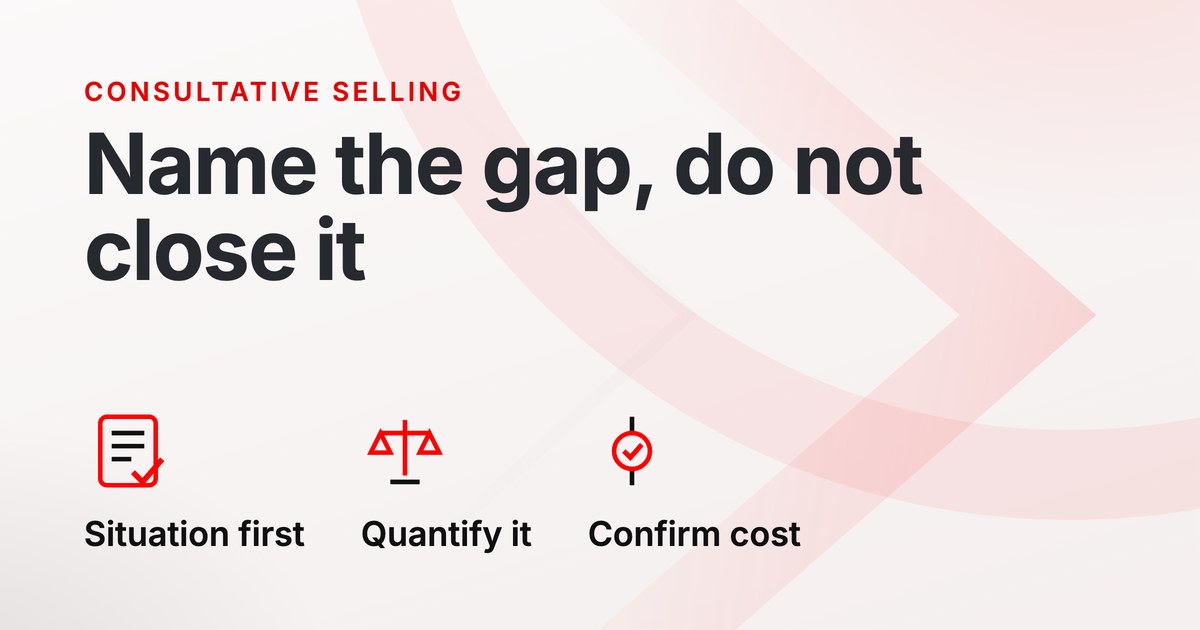
Name the gap without closing it. This is the discipline that separates consultative selling from free consulting. You can say with total clarity that their structure is creating an avoidable exposure, that fixing it takes a review and a restructure, and roughly what the shape of that work is. You do not have to walk through the restructure to prove you can do it.
Confirm the cost of doing nothing. Most firm proposals lose to inaction rather than to a competitor. If the buyer cannot articulate what happens if they do nothing, the proposal has no urgency, and no amount of follow up will supply it later.
Where Value Based Selling Fits
Consultative selling gets the diagnosis right. Value based selling is what you do with the diagnosis when it comes time to price. The two are usually taught together and they are not the same thing, and firms that do the first without the second end up with a beautifully diagnosed problem priced by the hour.
The practical link is simple. The number your prospect gave you when you asked them to size the problem is the number your fee gets compared against. Get the sizing question wrong and your fee has nothing to sit next to.
Qualification Comes First
None of this works on the wrong prospect. A consultative conversation with someone who cannot buy is just an expensive way to spend a Tuesday, and firms tend to be far too willing to have it. Our guide to qualifying accounting firm prospects before the sales call covers the front end of this, and it is the cheapest improvement most firms can make.
Making It Stick
Reading about consultative selling changes nothing on its own, which is the frustrating part. The gap between knowing the four moves and running them under pressure with a prospect who wants free advice is where the actual work sits. That is what Firm Huddle installs and then reinforces through call review afterwards, week after week rather than in a single sitting.
If your conversations are diagnosing well and converting badly, book a call and bring a recording. The pattern is usually visible in the first six minutes.
FAQ
What is an example of consultative selling?
A firm owner takes a call from a growing e-commerce business. Instead of describing the firm’s packages, they ask how the business currently handles multi state filing, what happened at the last deadline, and what that cost in penalties and internal time. The prospect names a figure. The owner explains that the exposure comes from where the entity sits rather than from how the returns are filed, says that fixing it starts with a structure review, and stops there. The proposal that follows is priced against the figure the prospect named.
What are the 5 steps in strategic consultative selling?
Most versions run as research, ask, listen, diagnose, and recommend. Research means knowing the prospect’s business before the call. Ask and listen are separate steps on purpose, because the listening is where people fail. Diagnose means forming a view and stating it. Recommend means proposing a specific path with a price attached. The order matters more than the labels.
What are the 3 C’s in sales?
Commonly given as connect, convince, and close. For firms we would translate that as earn the right to ask, build the case with the buyer’s own information, and ask for a decision rather than for permission to send a proposal.
Is consultative sales a skill?
Yes, and it is a trainable one, which is the good news for technical people who assume selling is a personality trait. The questioning discipline, the sizing question, and the ability to stop talking after naming a gap are all learnable behaviors. They just do not survive on knowledge alone, which is why call review matters more than the workshop.